Open any industrial vacuum catalog, and you will always see one line: Airflow (m³/h). Some machines show 268. Some show 1450. Some dust collectors show 23500. What does this number mean? And what changes when the number gets bigger? This post explains it in simple words, with real data from the ENDUSTMAN catalog.
What Is Airflow?
Airflow = the volume of air a vacuum sucks in per unit of time.
Simple words: how much air (with dust inside) the machine can move every hour.
Think about breathing. When you breathe fast, you move more air. An industrial vacuum is the same. The airflow number tells you how much dust-laden air goes through the hose in one hour.
Airflow does not tell you “how strong” the machine is. That is another parameter — Suction (kPa). Airflow tells you how much the machine can carry away. We will talk about this difference in Section 3.
Two Units: m³/h and L/min
In the ENDUSTMAN catalog, most electric models use m³/h (cubic meters per hour). But the pneumatic (air-powered) models use L/min (liters per minute). For example, the pneumatic models ERTS30 and ERTD70 both show 4360 L/min.
These two units measure the same thing. You can convert them with one simple formula:
m³/h = L/min × 60 ÷ 1000
Example: 4360 L/min × 60 ÷ 1000 ≈ 261.6 m³/h
So the ERTS30 and ERTD70, at 4360 L/min, move about 261.6 m³ of air per hour. That is close to the small 220V electric models.
💡 Pro Tip
Before you compare two machines, always convert the airflow to the same unit. 4360 L/min looks like a huge number, but it is only about 261.6 m³/h. Same machine, same power — just a different unit.
Airflow Decides “How Much”, Suction Decides “How Hard”
Many buyers mix up airflow and suction. They are two different things:
A simple picture: suction is how hard you suck a drink through a straw. Airflow is how much drink passes through the straw every minute. For cleaning a big factory floor with light dust, you want a “big straw” — high airflow. For picking up steel grit or stones, you want a “strong mouth” — high suction. In most cases, when one goes up, the other goes down. Good machine design balances both.
Real Numbers from the ENDUSTMAN Catalog
Now let’s look at real models. The table below shows airflow numbers from small to big, and what each level is good for.
Model | Series | Power | Airflow | Best For |
|---|---|---|---|---|
EATD12C | 220V Cleanroom Vacuum | 1200 W | 268 m³/h | Cleanrooms, food & pharma, fine dust |
EATD24 | 220V Split-Tank Vacuum | 2400 W | 320 m³/h | Factory floor dust, cement, flour |
EHTD40 | 380V Compact Split-Tank | 4000 W | 410 m³/h | Metal chips, glass, sand; continuous work |
EHFD75 | 380V Heavy-Duty Vacuum | 7500 W | 540 m³/h | Steel grit, stones, heavy debris |
EHFD250 | 380V Heavy-Duty Vacuum | 25 kW | 1450 m³/h | Large factories, very heavy dust load |
ECH22M | Large Dust Collector | 22 kW | 12800–23500 m³/h | Whole production lines, many suction points |
Look at the gap. From 268 m³/h (EATD12C) to 1450 m³/h (EHFD250), the airflow is more than 5 times bigger. And the ECH22M dust collector, at up to 23500 m³/h, is about 88 times the EATD12C. These are not “better” or “worse” machines. They are machines for completely different jobs: one cleans a cleanroom corner, the other serves a whole production line.
Bigger Airflow Is Not Always Better
High airflow is great for light dust over big areas — flour, cement powder, carbon powder on a large workshop floor. But big airflow has a price:
⚠️ Do Not Over-Buy: A 23500 m³/h dust collector for one small workshop is like using a fire hose to water flowers. You pay more for the machine, more for electricity, and get more noise — for dust that a 320 m³/h machine could handle. Match the airflow to the real job.
How to Choose: Match Airflow to Your Job
Use this simple guide when you read the airflow number in the catalog:
💡 Pro Tip
Airflow drops when the filter gets dirty. A machine with a bigger filter area keeps its airflow stable for longer — that means less cleaning stops and more real work done. We will explain Filter Area (cm²) in another post of this series.
In Short
Airflow is the volume of air a vacuum moves per hour. It decides how much dust you can carry away and how fast you can clean a big area. Convert m³/h and L/min before you compare. And remember: the right number is better than the biggest number.
- What Is Airflow in Industrial Vacuums? Decoding m³/h and L/min
- What Does Suction (kPa) Really Measure? Understanding Vacuum Pressure
- 30 L to 140 L: Bigger Tank Isn’t Always Better
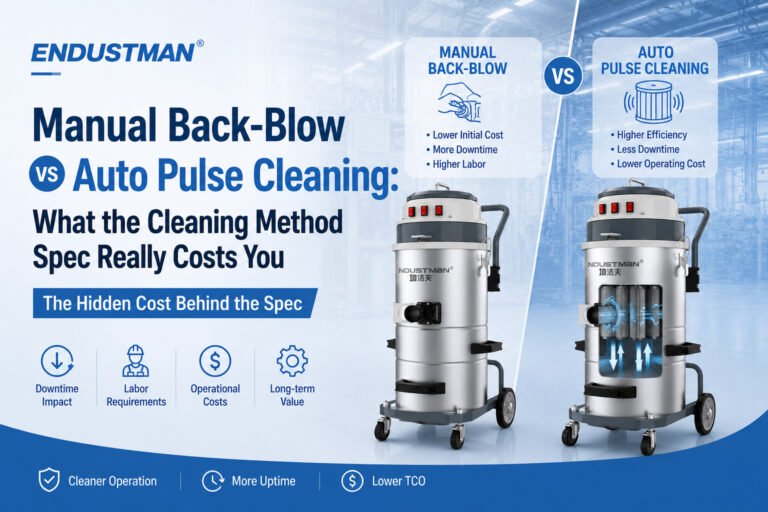
- Manual Back-Blow vs Auto Pulse Cleaning: What the Cleaning Method Spec Really Costs You
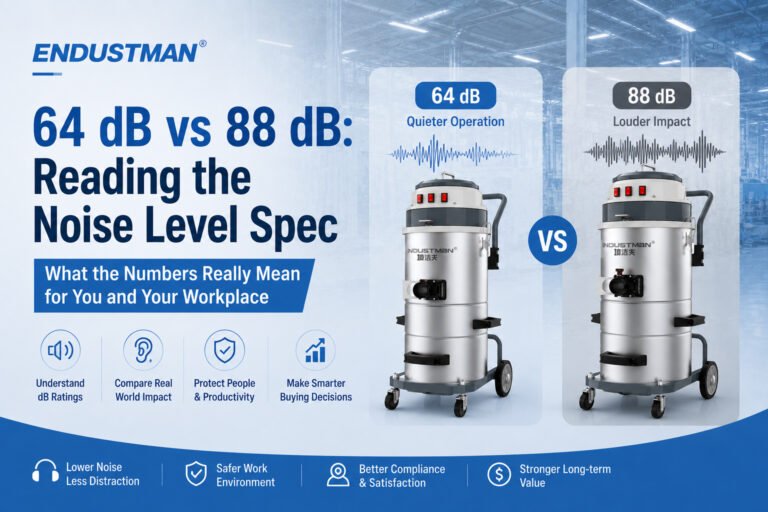
- 64 dB vs 88 dB: Reading the Noise Level Spec
- Filter Area: The Parameter That Decides Whether Suction Fades